Nisarga (Nature)
All animate and inanimate existence upon the earth
remains bound together through subtle and often invisible relationships. At
times these connections arise from emotional affinity, at others from mutual
dependence. Sensibility itself may be visual, experiential, or deeply
intuitive, just as dependence may assume innumerable forms. Yet for a painter,
the attraction toward nature and the inner reliance upon it endure throughout
an entire lifetime. From nature the artist receives impressions, and around it
the creative universe continually unfolds. One painter may be captivated by the
changing moods of the seasons, another by the multivalent splendour of colour
and atmosphere. When an artist has spent long years immersed within the rhythms
of nature—living amidst it, wandering through it, growing up in intimate
companionship with it—the resulting works inevitably attain greater emotional
depth and authenticity. It is for this reason that the entire creative world of
Awadhesh Misra is permeated by an intense and deeply charged expressiveness of
feeling.
Sensitivity has often been regarded as the primal source
of artistic expression. It is absorbed into consciousness where innumerable
experiences already reside in latent form; gradually these emotional residues
merge with perception and begin to reveal themselves through creation. From
this union arise subjects that remain profoundly connected both to the artist’s
inner consciousness and to the external realities surrounding him.
Consequently, the true personality of an artist ultimately manifests itself most
authentically through his works.
Awadhesh Misra is an exceptionally sensitive painter who
churns oceans of emotion into the language of line and colour. His artistic
universe encompasses works inspired by nature, society, politics, and the
larger dilemmas of humanity. At one moment the anguish of civilization appears
embedded within landscapes of nature; at another, social and political
anxieties emerge through symbolic visual structures of remarkable intensity.
Even the textures within his paintings seem alive, charged with the same vitality
and turbulence that inhabit his personal existence.
Awadhesh presents the wondrous lyrical essence of nature
through compositions marked by serenity and contemplative grace. He has devoted
the fullness of his lucid emotional experience to the beauty of the natural
world, where the pulsating song of life within nature has continually animated
his imagination. Yet within these depictions of nature one also encounters the
silent scream of human suffering. As an artist profoundly connected to both
society and the natural environment, his mind is ceaselessly drawn back toward
them. Though today he is an established artist residing far away in Lucknow,
distant from the rural landscape of his origins, his troubled spirit repeatedly
returns in memory to that earlier world of belonging and harmony. This
separation from his village, society, and nature itself appears to summon him
through a silent invitation, compelling him to create series after series in an
attempt to soothe an unspoken inner pain.
One particular painting by Awadhesh remains deeply etched
in memory. In it, nature is represented through an overwhelming expanse of
darkness enveloping the entire universe. The composition is divided into two
principal sections, one of which assumes the vastness of the sky rendered in
deep black tones. For after emotional devastation, darkness alone seems visible
everywhere. Yet somewhere within that darkness, the flame of hope continues to
endure. Symbolically, a sun emerges faintly from within the obscurity,
appearing as though it were melting and weeping at once. It struggles
repeatedly to regain composure, though without success. Thin black lines spread
across the surface of the painting, evoking the entanglements and psychological
knots that imprison human consciousness. The blackness descending from the sky
toward the earth in undulating forms suggests a cosmic crisis, as though
creation itself were gradually dissolving into annihilation. Below, streaks and
splashes of red form a flowing current that appears to embody emotional
fracture and psychic collapse.
In another painting from the same series, nature assumes
an altogether different temperament—calm, luminous, and inwardly composed. A
faint veil of light reminiscent of the first radiance of dawn spreads gently
across the composition, expressed through muted yellow tones. Upon the sky
appears a solitary red point, symbolic of energy and rhythmic vitality. Beneath
it emerge white and blue cloud formations, while deeper shades of blue above
and below them create the impression of lingering shadows. The image seems to
articulate the truth that although the past recedes with time, it continues to
accompany human life like a shadow from which one can never entirely escape.
White streams descending from the clouds cover much of the lower space,
suggesting an overwhelming sense of emptiness. Amidst this lower expanse
appears a wavering red line surrounded by blackness, silently declaring that
life may remain connected to the past, yet it cannot be wholly governed by it.
The past resembles a dream—something that may be remembered and imagined,
though never used as the sole foundation upon which the future may be
determined. For this reason, the descending white currents touch the lower
region only partially. The painting thus appears to affirm that consciousness,
subconsciousness, and the half-conscious mind remain perpetually active within
human existence, though circumstances may cause one realm to dominate the
others at different moments.
Another work within the series offers a tranquil and
expansive vision of nature stretching endlessly into the distance with
extraordinary serenity and attraction. Fresh, luminous colours dominate the
composition. According to Awadhesh, the sky has been rendered almost entirely
vacant except for the form of the sun painted in radiant red. Above it hovers a
subtle veil of dark green clouds seemingly eager to conceal the sun, while the
sun itself appears to melt inwardly even as it awakens the world through its
gentle radiance. One senses that the sun continues to offer energy and warmth
despite its profound solitude within the vast sky. From this crimson orb,
streams of red descend downward, suggesting emotional dissolution; yet through
its brilliant intensity the sun continues to imagine itself strong and
self-sustaining. Below this appear four layered waves rendered in varying
tonalities of green. The uppermost layer, composed of pale sky-green hues,
signifies the illumination of hope within the mind. The subsequent layers
deepen into grey and dark green, while the final layer descends into blackness,
together symbolising the intertwined continuum of past, present, and future.
Through this composition, Awadhesh Misra articulates the expansive interplay of
light and shadow within human emotion. As he himself suggests, one must honour
the rose together with its thorns; rather than surrendering to sorrow, one must
struggle against despair and ultimately transcend it.
In yet another painting from the series, adverse
circumstances dominate the emotional atmosphere, leading to the pervasive use
of black throughout the composition. According to the artist, the upper portion
contains a solar form enclosed within a protective covering, suggesting the
existence of an unseen force safeguarding humanity. From within this covering,
divine light emerges intermittently, symbolising resilience amidst adversity
and an unwavering commitment to serve collective human consciousness. Despite
the predominance of black, subtle illuminations of yellow-tinted brown generate
a faint but persistent glow across the surface. In the lower section, two
scattered red lines extend horizontally from one edge of the painting to the
other, the upper line smaller and the lower more expansive. Together they seem
to proclaim that life itself is a journey which every human being is destined
to complete, regardless of how difficult or hostile its stages may become. In
order to reveal these mysterious emotional states, Awadhesh Misra employs
flashes of intense red sparingly yet with profound emotional force,
transforming colour itself into a testament to the depth of the artist’s
sensitivity.
 |
| Awadhesh Misra, Composition-3-2001, Oil on Canvas, 90x90cm |
 |
| Awadhesh Misra, Composition-1 -2003, 90x120cm, Oil on Canvas |
 |
| Awadhesh Misra, Composition-1- 2005, 90x120cm |
 |
| Awadhesh Misra, Composition-1, 1996, Oil on Canvas 75x90 cm |
 |
| Awadhesh Misra, Composition-1, 1997, 120x180 cm |
 |
| Awadhesh Misra, Composition-1, 2002, Oil on Canvas, 90x120cm |
 |
| Awadhesh Misra, Composition-1,2006,Oil on Canvas, 76x76cm |
 |
| Awadhesh Misra, Composition-1-2001, Oil on Canvas, 90x120cm |
 |
| Awadhesh Misra, Composition-2- 2004, 90x90cm, Oil on Canvas |
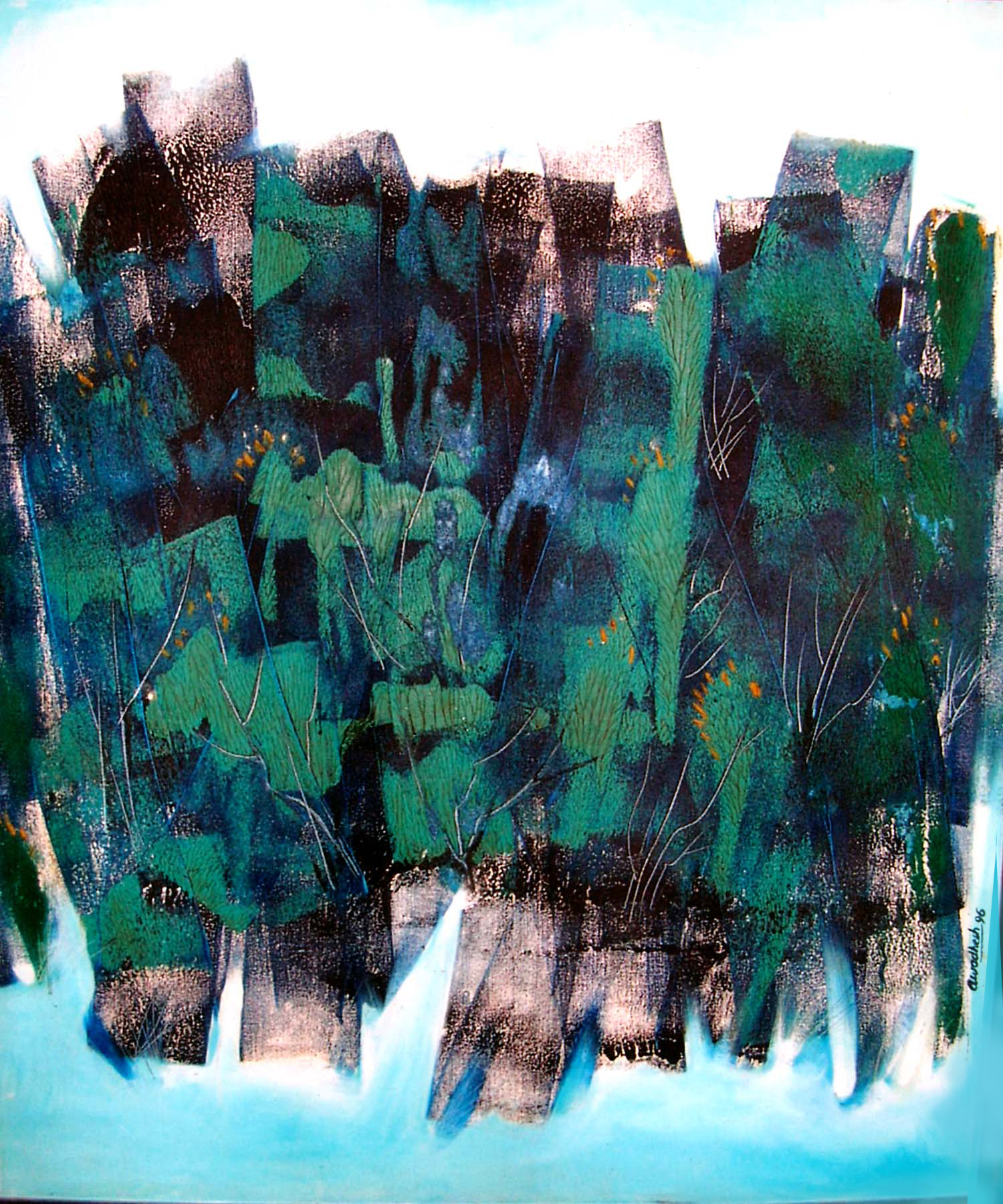 |
| Awadhesh Misra, Composition-2, 1996, Oil on Canvas 75x90 cm |
 |
| Awadhesh Misra, Composition-2, 1997, 120x180cm |
 |
| Awadhesh Misra, Composition-2,2006,Oil on Canvas, 59x75cm |
 |
Awadhesh Misra, Composition-3, 1996, Oil on Canvas, 75x75cm
NOT AVAILABLE |
 |
Awadhesh Misra, Composition-4- 2001, Oil on canvas, 90x90cm
NOT AVAILABLE |
 |
| Awadhesh Misra, Composition-5- 2001, Oil on Canvas, 90x90cm |
 |
| Awadhesh Misra, Composition-15,2007,Oil on Canvas, 120x150cm |


Comments
Post a Comment